Circadian Rhythms and Morning Sunshine (how LIGHT changes your hormones, vision, & entire well-being)

First - if you’re new here - welcome! Fallon’s Table blog is your home for nourishing recipes, whole-food desserts, escaping diet culture, attainable holistic living, and seasonal comfort meals made with real ingredients. My heart is all about family-friendly recipes inspired by REAL food and ancestral cooking designed for modern kitchens!
I’m a Certified Nutritional Practitioner and recipe developer who helps women feel empowered in their health journey, learn how to confidently eat well, find healing and support during chronic illness, and gain kitchen confidence through simple, delicious recipes for you and your family!
Health Benefits of Sunshine (for hormones, vision, and more!)
A couple of years ago, I started really prioritizing having healthy, sun-guided lighting in my home and rhythms. What do I mean by that exactly? In a nutshell, rising with the sun, dimming lights at night when the sun has gone down, and getting sunshine on my bare eyes first thing in the morning.
The results? (Achieved by a myriad of things of course, but I do believe this to be one of the biggest contributing factors!)
My Hashimoto’s went into remission this year and my antibodies are the lowest they’ve ever been.
My internal peace and regulation is more consistent than ever.
My son’s and my eyeglasses prescriptions and vision are improving.
Can you believe that?!
Again, most disease, limitations, symptoms, etc. are not mono-causal, nor or they mono-solutional. Yes, I might have made up that word. But considering what we know about sunshine, circadian rhythm health, hormones, and vision as a connected story, it’s not surprising that I’ve experienced such incredible results!
Today we’re going to walk through a few topics: what IS our circadian rhythm, what makes our circadian rhythms better or worse, how we can balance our circadian rhythms, how to get morning sunshine on our eyes, how morning sunshine can be a component of improving our vision, and how light has a direct effect on our hormone health (reproduction, stress, endocrine, etc), AND how we can have healthy lighting in our home!
First, let me share the most lovely little passage from Heidi. (I’m a science and health nerd and ALSO a literary nerd, turns out).
“Heidi was accustomed to get up early and run out at once to see how everything was looking, if the sky was blue and if the sun was already above the mountains, or if the fir trees were waving and the flowers had opened their eyes.”
We can learn a lot from simple children’s stories! The practice of running “out at once to see how everything {is} looking,” might be the easy, free secret to better health! 😉
An email pal sent me this verse as well: “Light is sweet, and it is pleasant for the eyes to see the sun." Ecclesiastes 11:7, ESV. While God and his goodness is our ultimate light and sun, I love this multi-layered reflection!
Isn’t the Lord so cool?!
What is Circadian Rhythm, anyway?
Our circadian rhythm, simplified, is our body’s internal daily clock. It influences our sleep-wake cycles, our ability to fall asleep easily and stay asleep, and is also directly connected to our nervous system. Our circadian health is the foundation for our hormone health as well - and while cortisol and melatonin are often thought as being connected to circadian rhythm (and they ARE), that’s not all! Estrogen, progesterone, testosterone, AND thyroid hormones can either be supported or imbalanced as a result of circadian rhythm health.
This is why in the work I’ve done one-on-one, one of my FIRST recommendations for establishing balance for any life stage, but especially with stress, sleep issues, hormone imbalances, blood sugar issues, etc., is to work toward balancing circadian rhythm. Which possibly sounds like a fancy set of words, but in truth is completely attainable. Let’s talk about how!
First, how do we get a messed up internal clock to begin with?
Factors that negatively influence our circadian rhythm:
Bright lighting at night, to include overhead lighting, TV screens, phones, etc.
Inconsistent eating patterns, including eating too late at night.
Intense workouts that are too early or too late (before sunrise or after sundown).
Lack of movement.
Inconsistent sleep rhythms/poor sleep hygiene (keeping bedtime and wake-up consistent, around 9-10pm, is a good aim!).
It’s a simple list to read (while not exhaustive), but can be harder to implement! While we know deep down that our late night phone and screen use is negatively affecting our health, I think we can often forget just how much.
How do we balance our circadian rhythm?
Hands down, the biggest piece of this puzzle is lighting. When we are constantly exposed to harsh, flickering indoor lighting (bulbs, screens, etc), our body can easily become confused. When the sun has gone down but our overhead lights are on and our phones are in our face and our TV is shining bright, it’s no wonder our bodies can’t grasp that it’s time to sleep soon!
There are truthfully, two very easy pillars to pursuing a circadian rhythm reset through your lighting:
Get morning sunshine on bare eyes (no contacts or glasses) and outdoors (not through a window), and take sunshine “breaks” throughout the day - something like 5-15 minutes in the mid-morning, mid-afternoon, and at sunset.
Match your indoor lighting to the sun rhythms (and better yet, try to use as minimal indoor lighting as possible!). If it’s dim/dark outside, it should be dim/dark inside. If the sun is up and bright, there’s usually no need to turn on artificial lighting anyway, just open those blinds and shades!
How to get morning sunshine on your eyes (for better vision, hormone health, and more!)
The process is truly quite simple, but there are a few details to keep in mind! Because, fun story - I have a beloved family member (you know who you are) who took my recommendation to get sunshine in the morning and nearly blinded himself on the drive to work trying to stare directly at the sun during his morning commute. DON’T DO THAT, OKAY. Let’s break down the particulars!
NO glasses or contacts. They often have UV protective coating and create a barrier between the beneficial rays we WANT and our eyes.
As little as 2 minutes is beneficial; 5-10 is even better!
It’s totally okay if it’s cloudy, rainy, or you can’t actually see the sun - the rays are still there and penetrating!
Windows do block the rays we want, so it does need to be outside (and please don’t hang your head out the window like a dog while driving to work like afore-mentioned family member).
If you wake up before the sun, just get sunshine when it does come up, and keep your lighting dim beforehand!
If the sun is fully visible and not getting any cloud coverage, please don’t blind yourself looking directly at it, again, like said family member 😂. Looking in the general direction of the sun is great!
And did you know - your eyes are a PART of your nervous system?! Sunlight (through our eyes) directly informs our sleep quality and nervous system regulation!
I realize that jobs and other rhythms can often make this process hard, and my advice is do what you can when you can. Something is better than nothing!
How we have GREATLY improved our vision through morning sunshine

Ya girl still has glasses, but my script keeps going down!
My oldest son and I both have seen drastic vision improvements from these practices (among a few others I’ll share about another time!).
As of 08/23/2023, my son’s script was +4.25 and +5.00.
As of 06/27/2025, it was +2.5 and +2.5.
(!!!!)
I’d like to provide the “receipts” here but am going to avoid uploading our personal medical info online haha.
My own prescription has gone from -3.5 and -2.75 in 2023 to today being -2.75 and -2.5 and still improving.
(Because my son is farsighted, he has been able to spend a LOT of time outdoors playing with no glasses and actually, does not wear glasses at all - that’s been a huge part of his improvement! We also have the freedom and flexibility to do this because he is homeschooled and it has not effected his learning or reading ability at all!)
Now I, clearly, am not running around glasses-less outside playing as a grown woman. There would be broken bones and loss of personal dignity involved if so. Which tells me that my morning sunshine exposure alone has made a huge impact on my vision!
While this seems CRAZY in a world where we are told we can never heal or fix our vision, the proof is in the pudding. And so is the science, turns out!
Spending more time outdoors has a direct correlated decrease in nearsightedness!
(and according to my son’s anecdotal experience, farsightedness, too!)
How to have healthy lighting in your home
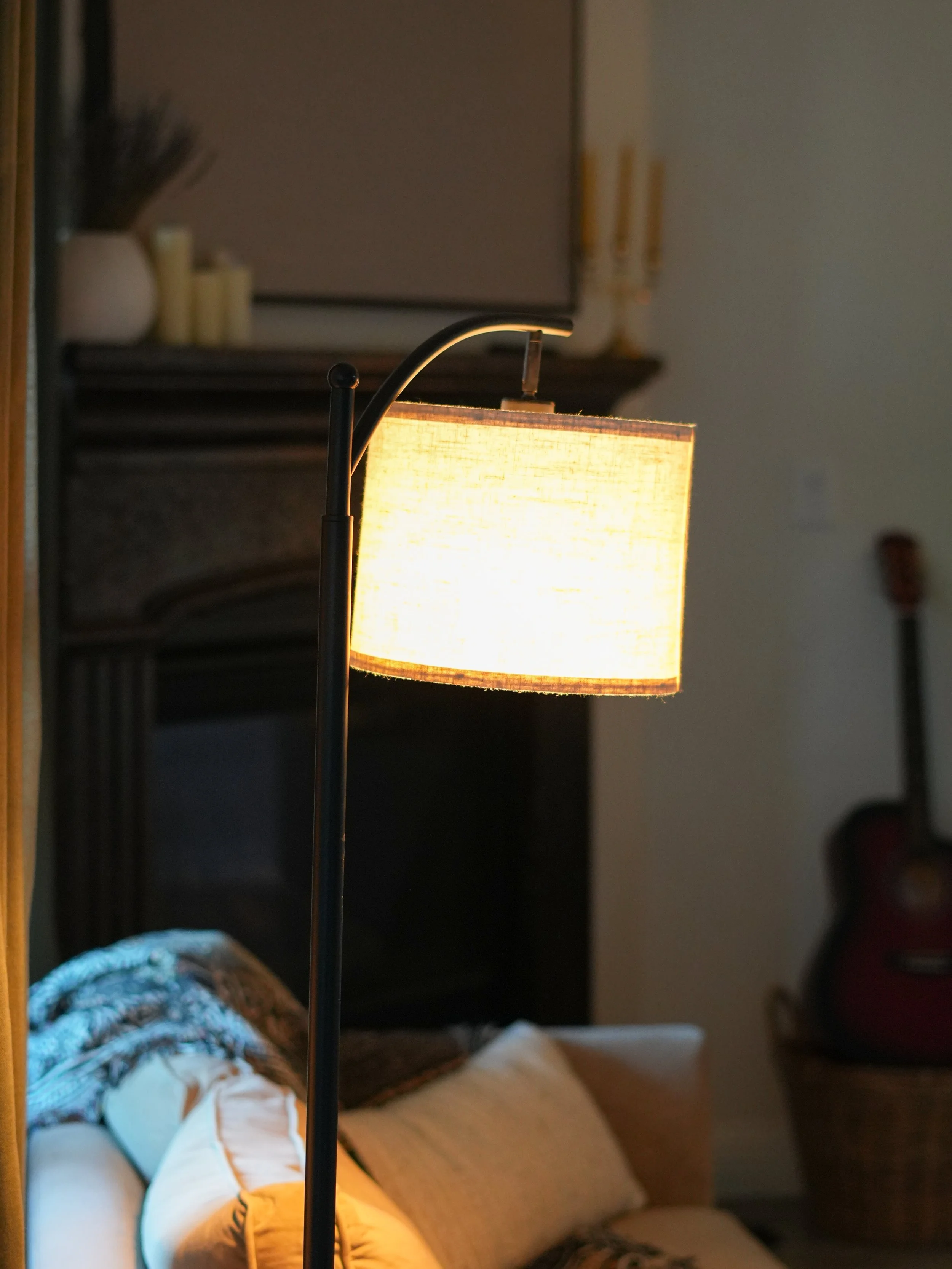
The EASIEST way to do this is free: don’t turn on lights 😂😉 Okay, okay, that’s not always possible. But when it IS possible in the brightest parts of the day, do that!
Otherwise, we can still prioritize dim lighting when needed (lamps, pure beeswax candles, etc) and there are great bulbs on the market that offer little to no flickering (high-flicker lighting is like a bad disco party to crash your nervous system and stress you out) and less intense blue light.
My favorite lighting company is linked here! I love finding healthy bulbs because it doesn’t take an overhaul of our home light fixtures - just get good quality lamp bulbs and focus on using those at night especially!
For non-toxic beeswax candles, and other favorites for the home, head to my linked collection here!
Thanks for reading, and I hope this helped encourage you in your health journey!
RELATED POST: My Hashimoto’s Journey and Going Into Remission
RELATED POST: Science-Backed, FREE Health Tips
RELATED POST: Sun Safety from a Holistic Perspective